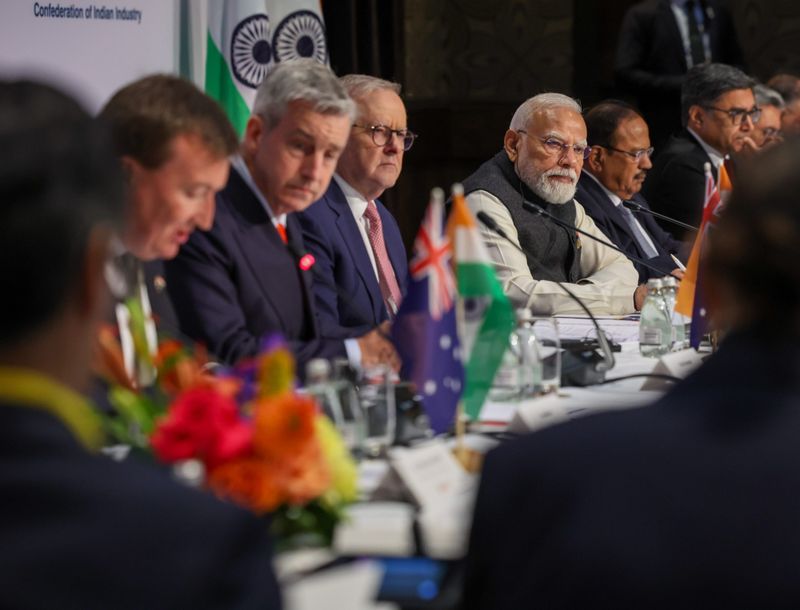
Prime Minister Narendra Modi on Thursday made a strong pitch for Australian investment in India’s newly liberalised nuclear energy sector, highlighting the country’s vast uranium reserves as a “historic opportunity” to power India’s clean energy transition.
Addressing the India-Australia Economic Roadmap Business Reception in Melbourne, Modi said India had recently opened its civilian nuclear sector to private participation through the SHANTI Act and set an ambitious target of generating 100 GW of nuclear power by 2047.
“Australia’s vast uranium reserves are directly linked to India’s nuclear journey. There is a historic opportunity for the two countries to expand cooperation in this sector,” he said.
Projecting India as one of the world’s fastest-growing investment destinations, Modi also invited Australian businesses to participate in sectors ranging from renewable energy, infrastructure and critical minerals to artificial intelligence, semiconductors and quantum technologies.
He said India had already committed more than $10 billion under its AI Mission, Quantum Mission and Semiconductor Programme and was looking to jointly develop global solutions with Australia in data centres, AI, quantum computing, semiconductors and digital public infrastructure.
The Prime Minister underlined that India and Australia had emerged as “natural and trusted partners” at a time when the world was grappling with geopolitical uncertainty, supply chain disruptions and energy insecurity.
“Today, when the world is passing through uncertainty, supply chain disruptions and an energy crisis, it is both natural and necessary for India and Australia to move forward as trusted partners,” he said.
Modi said the India-Australia Economic Cooperation and Trade Agreement (ECTA), signed in 2022, had significantly strengthened bilateral economic ties, with India’s exports to Australia doubling since its implementation. He said both countries were now working towards concluding the Comprehensive Economic Cooperation Agreement (CECA), which would further expand trade and investment.
Highlighting India’s clean energy ambitions, Modi said the country was building a manufacturing ecosystem for green hydrogen, solar modules, wind turbines and hydropower equipment.
He reiterated India’s target of achieving 500 GW of renewable energy capacity by 2030 and net-zero emissions by 2070, saying Australian technology, capital and resources could accelerate this transition.
The Prime Minister also sought greater Australian investment in India’s infrastructure sector, pointing to the country’s rapid expansion of highways, railways, airports and urban infrastructure.
“India today is building nearly 34 km of national highways every day and laying more than eight kilometres of railway tracks daily. This is a unique combination of scale, speed and stability,” he said.
Calling critical minerals another pillar of future cooperation, Modi said Australia’s mineral resources could complement India’s manufacturing capabilities, particularly in sectors such as electric mobility, clean energy and advanced manufacturing.
He also identified steel, low-carbon aluminium and green iron as emerging areas for bilateral industrial collaboration.
Seeking to attract long-term Australian institutional capital, Modi said Australia’s pension funds, which manage assets worth over $4 trillion, would find India a safe, stable and sustainable investment destination.
“India considers pension savings a sacred trust of millions of families. We see it not merely as capital but as people’s trust. Our endeavour will be to ensure that both your trust and your capital grow in India,” he said.
On education, Modi said collaboration should move beyond student mobility towards talent partnerships, noting that Australian universities such as Deakin University and the University of Wollongong had already established campuses in Gujarat’s GIFT City.
The Prime Minister also proposed deeper state-to-state partnerships, suggesting that Australia’s strengths in critical minerals, clean energy, finance, education, defence and innovation could be matched with the capabilities of Indian states such as Gujarat, Odisha, Maharashtra, Karnataka, Telangana, Uttar Pradesh, Kerala, Punjab, Tamil Nadu and Andhra Pradesh.
He said the growing strategic convergence between the two democracies and their shared Indo-Pacific vision provided a strong foundation for taking economic and business ties to the next level.