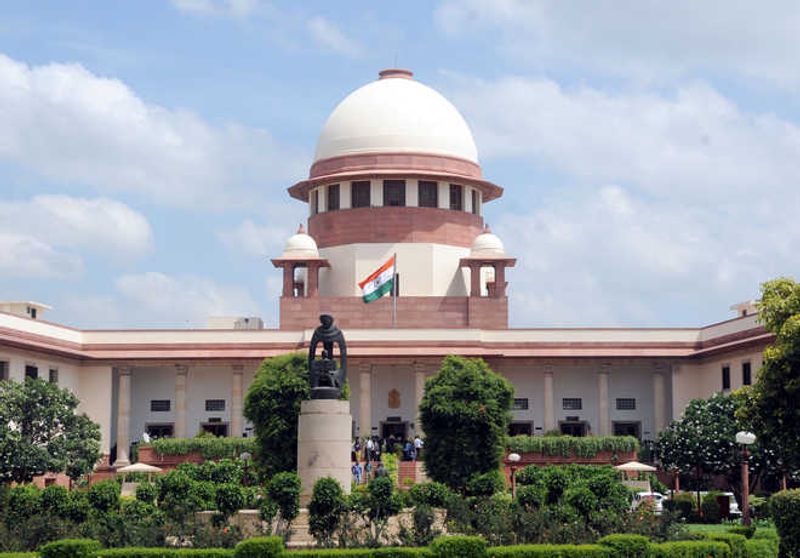
A nine-judge Constitution Bench of the Supreme Court on Thursday modified the expansive definition of ‘industry’ as interpreted in the seven-judge Bench judgment in Bangalore Water Supply & Sewerage Board versus R Rajappa & others in 1978.
Thereby, the 48-year-old expansive worker-friendly interpretation of the term “industry” will not apply to fresh cases under the Industrial Relations Code, 2020.
By a 5:4 majority, the nine-judge Constitution Bench, led by CJI Surya Kant, ruled that certain aspects of the triple test and the accompanying guidelines formulated in the 1978 judgment needed further refinement even as the essential framework laid down in the judgment had stood the test of time.
The top court, however, held that its ruling would apply prospectively and would not apply to pending disputes/cases. It also chose not to examine the new definition of ‘industry’ under the Industrial Relations Code, 2020.
While CJI Kant, Justices Satish Chandra Sharma, Alok Aradhe and Vipul M Pancholi were part of the majority verdict, Justice PS Narasimha wrote a separate judgment concurring with the CJI’s verdict on several crucial issues. Justices BV Nagarathna, Dipankar Datta, Ujjal Bhuyan and Joymalya Bagchi dissented.
While pronouncing the verdict, the CJI made clear that the “triple test”, evolved in the 1978 judgment authored by Justice VR Krishna Iyer to ascertain as to what constitutes an “industry” would remain valid.
He, however, said the “triple test” had been refined in the instant judgment but this could not be used in pending or decided cases under the now-repealed Industrial Disputes (ID) Act, 1947.
In its 1978 verdict in ‘Bangalore Water Supply and Sewerage Board versus A Rajappa’, the seven-judge Bench held that any systematic activity organised by cooperation between employer and employee for the production or distribution of goods and services could fall within the definition of ‘industry’, even if the organisation was not engaged in profit making.
The Centre had contended that welfare activities and charitable functions undertaken by the State could not be treated as “industry” under the labour law.
Attorney General R Venkataramani submitted that while the “triple test” evolved in the 1978 judgment may be logically sound; its indiscriminate application had led to an unwarranted expansion of the definition of “industry”. He had cautioned against an over-broad application of the test laid down in the 1978 verdict.
Earlier, a three-judge Bench, in its 1996 judgment, had relied on a 1978 seven-judge Bench verdict and had held that the Social Forestry Department was covered by the definition of the word “industry”.
Later, in 2001, another Bench took a different view on the issue, after which the matter was referred to a five-judge Bench to resolve an “apparent conflict” between the two decisions.
In May 2005, a five-judge Constitution Bench referred the matter to a larger Bench on the interpretation of “industry” in Section 2 of Industrial Disputes Act, 1947. A seven-judge Constitution Bench led by the then CJI TS Thakur in 2017 said that the appeals be placed before a Bench of nine judges keeping in view the “serious and wide-ranging implications” of the issue.