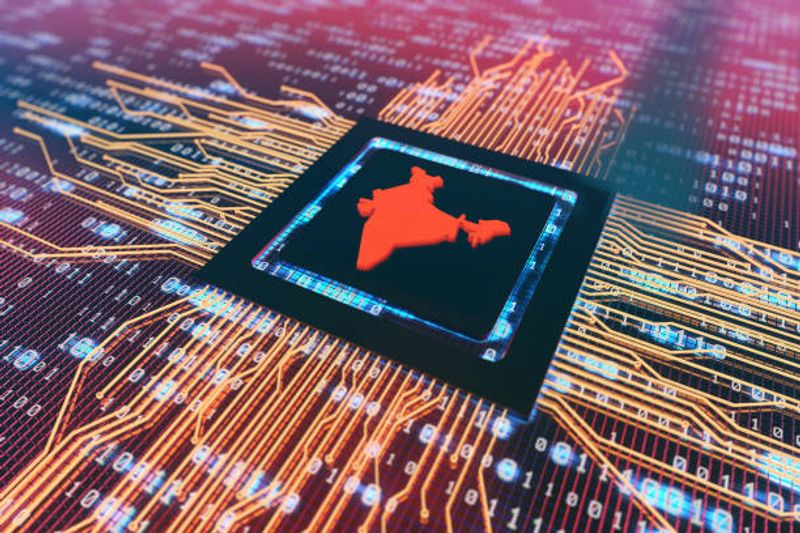
China’s export control and industrial security framework is emerging as a fresh challenge that could hinder India’s ambitions to become a global hub for electronics manufacturing, even as New Delhi steps up efforts to build domestic capacity in critical sectors such as semiconductors, mobile phones and rare-earth materials.
Beijing has recently introduced two significant state council decrees — 834 establishes a formal framework for identifying, monitoring and responding to risks affecting China’s industrial and supply chains while 835 refines China’s mechanism for identifying and responding to foreign laws and enforcement measures applied extraterritorially in China. Together, the measures are expected to tighten regulatory control over critical inputs and technologies that are deeply embedded in global electronics and energy supply chains.
China currently controls a significant share of global refining and processing capacity for critical minerals used in electronics, renewable energy systems, and defence technologies. Any tightening of exports or regulatory scrutiny could place additional strain on global manufacturing ecosystems, particularly in sectors reliant on rare earth elements, semiconductors and battery components.
Meanwhile, Rishabh Jain, Director, International Business at Petros Stone LLP, said the evolving global trade environment could work in India’s favour, particularly for sectors such as natural stone. “China’s tightening export controls and supply chain regulations present a strong opportunity for India to emerge as a more reliable and diversified global manufacturing destination,” Jain said.
He noted that India already possessed abundant raw material resources, a skilled workforce and expanding industrial capabilities in the natural stone sector. However, he emphasised that targeted investments in modern manufacturing facilities, advanced technology and stronger supply chain infrastructure would be critical for scaling up global competitiveness.
Indian electronics manufacturers, in particular, are reportedly cautious that the new Chinese measures could disrupt supplies of essential industrial machinery and intermediate inputs, potentially affecting production timelines and cost structures.
Experts warn that if these restrictions are fully enforced or expanded, India could face slower manufacturing expansion, higher input costs, and challenges in meeting export growth targets — especially for small and medium enterprises (SMEs). At the same time, the situation may accelerate efforts to diversify supply chains and develop domestic capabilities in strategic sectors.
India remains fully import-dependent for several critical elements, including lithium, cobalt, beryllium and graphite. Despite possessing significant rare earth reserves, domestic production of permanent magnets and advanced processing capabilities is still in a developing stage.
At present, a large share of India’s demand for rare-earth-based products is met through imports from China, which account for nearly 60-80 per cent of value terms and 85-90 per cent in volume terms between 2022 and 2025, according to official estimates.
Meanwhile, the Union Budget 2026–27 has placed strong emphasis on strengthening India’s self-reliance in critical materials. This includes the expansion of the Rare Earth Permanent Magnet (REPM) Manufacturing Scheme, alongside new corridor-based industrial initiatives aimed at building integrated supply chains for advanced materials.
Officials said these measures were designed to reduce import dependence, strengthen domestic manufacturing capacity, and position India as a competitive global player in strategic materials and high-tech industries.
India has already emerged as the world’s second-largest mobile phone manufacturer. Domestic production has grown sharply from Rs 2.14 lakh crore in FY 2019-20 to Rs 5.5 lakh crore in FY 2024-25. Mobile phone exports have also reached around Rs 2 lakh crore in FY 2024-25, reflecting strong integration into global value chains.
The semiconductor sector is also witnessing rapid expansion, supported by rising investments, policy incentives, and initiatives such as SEMICON India 2025. The Indian semiconductor market, valued at around $38 billion in 2023, is estimated to have grown to $45-50 billion in 2024-25 and is projected to reach $100-110 billion by 2030.
Semiconductors, which power everything from smartphones and computers to automobiles, defence systems and artificial intelligence, are central to India’s manufacturing ambitions.