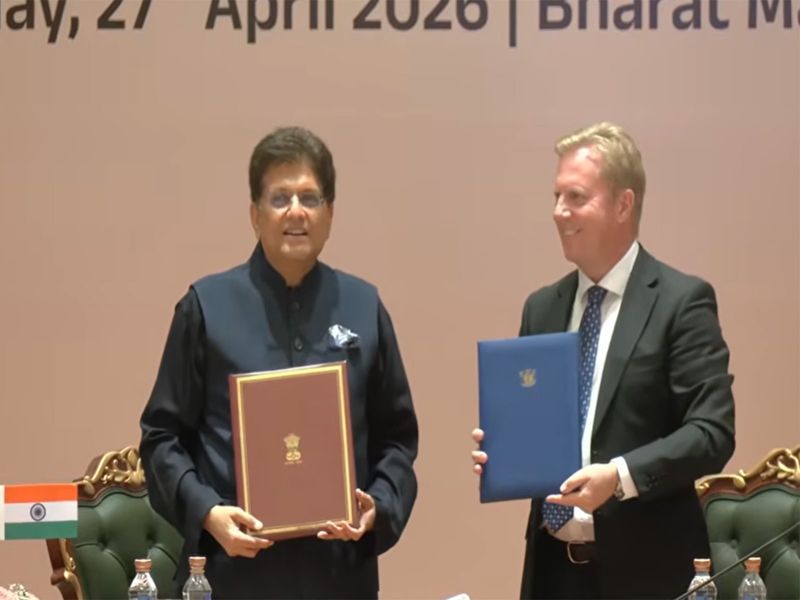
India and New Zealand on Monday signed the free trade agreement (FTA), granting duty-free access to all Indian exports to the island nation while protecting the country’s sensitive dairy and agriculture sectors. The agreement covers all tariff lines and significantly boosts micro, small, and medium enterprises (MSMEs) and generate employment.
The pact, signed by Union Minister of Commerce and Industry Piyush Goyal and New Zealand’s Minister for Trade and Investment Todd McClay, includes a commitment of facilitating $20 billion in investment into India. With zero-duty market access to New Zealand, Indian products will enjoy a level-playing field and directly support workers, artisans, women entrepreneurs, youth and MSMEs across the country.
Prime Minister Narendra Modi said the FTA marked a major milestone towards deeper global engagement and shared prosperity. “It strengthens economic ties between two vibrant democracies, unlocking opportunities for farmers, artisans, youth, entrepreneurs, women and MSMEs,” he said. New Zealand’s Prime Minister Christopher Luxon described it as a “once-in-a-generation agreement”.
The deal is expected to enhance competitiveness in labour-intensive sectors, such as textiles, apparel, leather, footwear, gems and jewellery, engineering goods and processed foods.
The Ministry of Textiles, on its official X handle, wrote, “India’s textile sector gets a massive boost under the India-New Zealand FTA. Zero-duty access for apparel, home textiles and handlooms means higher exports, more jobs for women and youth and stronger global value chain integration.”
Furthermore, India secures duty-free inputs for its manufacturing sector, including wooden logs, coking coal, and waste and scraps of metals, lowering production costs and enhancing the global competitiveness of Indian industry.
As part of the agreements, India has offered tariff liberalisation on 70.03 per cent of tariff lines covering 95 per cent of bilateral trade value, while excluding 29.97 percent of tariff lines to protect sensitive sectors.
With this, 30 per cent of tariff lines will have immediate duty elimination, covering wood, wool, sheep meat, leather-raw hides, etc. About 35.60 per cent of tariffs on petroleum oil, malt extract, vegetable oils, selected electrical and mechanical machinery, peptones, etc, are subject to phased elimination over three, five, seven and 10 years.
Also, 4.37 per cent of products, such as wine, pharmaceutical drugs, polymers, aluminum, iron and steel articles, face tariff reductions. Mānuka honey, apples, kiwi fruit and albumins, including milk albumin, fall under tariff rate quotas.
Meanwhile, the products that are kept in exclusion are mainly dairy (milk, cream, whey, yoghurt, cheese, etc), animal products (other than sheep meat), agricultural products (onions, chana, peas, corn, almonds, etc.), sugar, artificial honey, animal, vegetable or microbial fats and oils, among others.